
Why Your ₹25 Lakh Car's ADAS Can Still Fail in India
Table of contents
Before You Lose Faith in Your Car's Safety Features, Read This.
You bought a new SUV.
Maybe it's a Mahindra XUV700, Tata Harrier EV, Hyundai Creta, MG Hector, Mahindra BE.06, or another vehicle equipped with Advanced Driver Assistance Systems (ADAS).
The salesperson demonstrated how the car could:
Warn you before a collision.
Brake automatically in an emergency.
Keep itself centred in the lane.
Maintain a safe distance from the vehicle ahead.
It felt like the future had arrived.
Then, a few weeks later, something unexpected happened.
Your lane assist stopped working on a highway.
The automatic emergency braking didn't activate when a motorcycle suddenly appeared.
Adaptive cruise control disengaged in traffic.
Suddenly, you're asking the same question thousands of Indian drivers search online every month:
"Did my ADAS fail?"
The answer is usually no.
Most of the time, your ADAS didn't fail, it encountered conditions that pushed it beyond its operational limits.
Understanding those limits doesn't make ADAS less valuable. It helps you use it more effectively and more safely.
Why This Question Matters More Than Ever
India is seeing rapid adoption of ADAS-equipped vehicles. Features that were once limited to luxury cars are now available in mainstream SUVs and sedans.
At the same time, India continues to face one of the world's largest road safety challenges.
According to the Ministry of Road Transport and Highways (MoRTH) Road Accidents in India 2023 report:
4,80,583 road accidents were reported.
1,72,890 people lost their lives.
Nearly 4.63 lakh people were injured.
These numbers explain why technologies such as ADAS are becoming increasingly important but they also highlight why those systems must work reliably in Indian conditions.
ADAS Was Never Designed to Replace You
One of the biggest misconceptions is that ADAS makes the vehicle "self-driving."
It doesn't.
Most passenger vehicles sold in India today offer Level 2 ADAS.
That means:
The car can assist with steering.
It can assist with braking.
It can assist with acceleration.
But the driver remains responsible at all times.
Think of ADAS as a highly attentive co-driver.
It can warn you.
It can assist you.
Sometimes it can intervene.
But it cannot replace your judgement.
The Biggest Difference: Indian Roads Are Exceptionally Complex
Many ADAS technologies were initially developed and validated on roads where:
Lane markings are clearly visible.
Traffic follows lane discipline.
Pedestrians cross at designated crossings.
Vehicles move predictably.
Now compare that with a typical commute in India.
Imagine driving from Pune to Mumbai during the monsoon.
Within one hour, your vehicle may encounter:
A biker filtering between two trucks.
An auto-rickshaw stopping suddenly to pick up passengers.
A tractor entering the highway from a village road.
Lane markings disappearing due to resurfacing work.
A stray dog crossing unexpectedly.
Heavy rain reducing visibility.
Water spray from trucks covering your windshield.
To an experienced driver, this is familiar.
To an ADAS system, it's a constantly changing environment requiring split-second interpretation.
Why Does Lane Assist Suddenly Stop Working?
One of the most common complaints among ADAS users is:
"My Lane Keep Assist stopped working."
In most cases, nothing is broken.
Lane Keeping Assist depends primarily on a forward-facing camera that identifies lane boundaries.
If the camera cannot confidently detect those markings, the system disengages because making an incorrect steering correction could be more dangerous than making no correction at all.
Common reasons include:
Faded lane markings.
Road construction.
Temporary diversions.
Mud or standing water covering lane paint.
Night driving with poor illumination.
Sun glare.
Heavy rainfall.
In other words, the system is choosing safety over uncertainty.
Why Didn't Emergency Braking Activate?
Autonomous Emergency Braking (AEB) is one of the most valuable ADAS features—but it's also one of the most misunderstood.
Drivers often assume:
"If there's something in front of me, the car should brake."
Reality is far more complicated.
Before applying the brakes, the system evaluates questions such as:
Is the object actually in your path?
Is it moving?
Is it stationary?
Is it crossing?
Will the driver react first?
Would emergency braking create a greater risk from vehicles behind?
Now consider an Indian intersection.
A scooter darts between lanes.
A pedestrian crosses diagonally.
An auto changes direction without indicating.
The available reaction time may be less than a second.
Sometimes the safest decision is to alert the driver rather than initiate full braking.
Cameras Are Extremely Capable but They Can't See Everything
Modern automotive cameras are remarkable.
They can recognise:
Lane markings.
Speed signs.
Traffic lights.
Pedestrians.
Cyclists.
Vehicles.
However, cameras depend on one critical requirement:
They need a clear view.
Camera limitations include:
Heavy rain.
Dense fog.
Dust.
Direct sunlight.
Headlight glare.
Dirty windshields.
Low-light conditions.
If visibility decreases, the camera's confidence decreases too.
Radar Sees the Road Differently
Unlike cameras, radar doesn't rely on visible light.
Instead, it sends radio waves and measures their reflections to determine:
Distance.
Relative speed.
Direction of movement.
Because of this, radar performs well even in:
Rain.
Fog.
Dust.
Darkness.
Sun glare.
This is one reason radar has become a foundational sensor in many advanced ADAS systems.
However, radar also has limitations.
It cannot read traffic signs or interpret lane markings the way cameras can.
Camera vs Radar: Which Is Better?
The better question isn't which sensor is better.
It's why modern ADAS increasingly uses both.
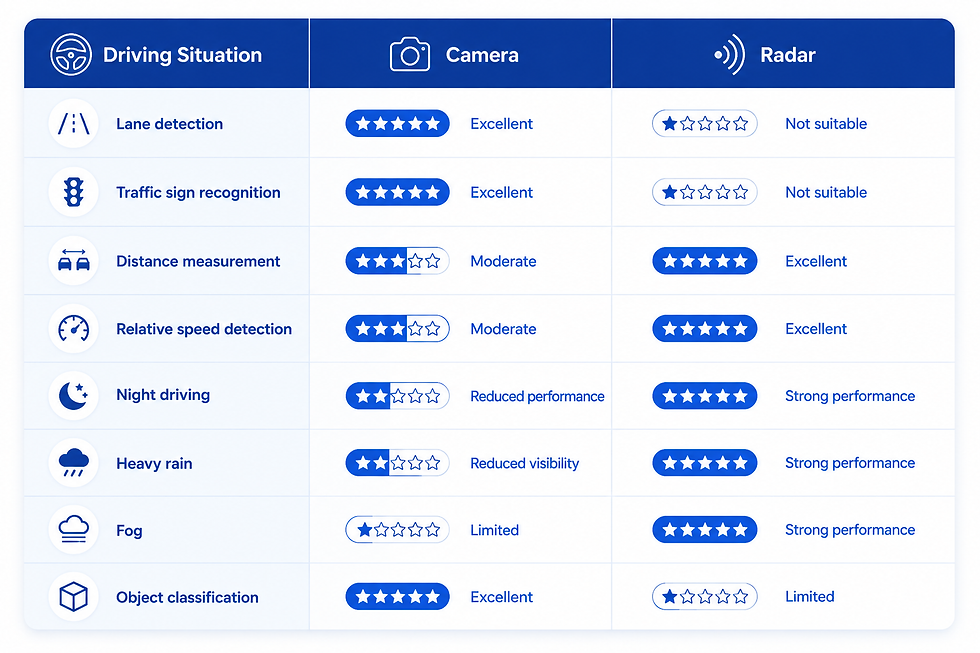
Each sensor compensates for the other's weaknesses.
Sensor Fusion: The Technology Behind More Reliable ADAS
Rather than relying on a single sensor, many modern ADAS platforms combine information from multiple sources.
This approach is known as sensor fusion.
For example:
A camera identifies a cyclist.
Radar calculates the cyclist's exact distance and closing speed.
The software combines both inputs before deciding whether to warn the driver or intervene.
Instead of asking one sensor to do everything, the vehicle builds a richer understanding of its surroundings.
For Indian roads, where traffic is dense and unpredictable, this layered perception becomes increasingly important.
Four Real Indian Scenarios Where ADAS Is Challenged
Scenario 1: The Mumbai-Pune Expressway
Heavy rain.
Truck spray.
Faded lane markings.
Lane Assist temporarily disengages because the camera cannot reliably identify lane boundaries.
Scenario 2: Bengaluru Outer Ring Road
A motorcycle squeezes between two buses.
An auto-rickshaw brakes abruptly.
The system has milliseconds to determine whether emergency braking is appropriate.
Scenario 3: Rural Highway at Night
A cow walks onto the road.
There are no streetlights.
The camera has limited visibility.
Radar may detect the obstacle sooner because it is less affected by darkness.
Scenario 4: Delhi Traffic
Vehicles occupy multiple informal lanes.
Drivers constantly merge without indicators.
Predicting future vehicle movement becomes significantly more difficult than on orderly highway traffic.
What Will Make ADAS Better for India?
The future isn't simply adding more sensors.
It's making those sensors understand Indian driving better.
Key areas of improvement include:
AI Trained on Indian Roads
Machine learning models improve when trained using local traffic behaviour rather than assuming global driving patterns.
Better Radar Integration
Increasing reliance on radar improves perception during adverse weather and low-visibility conditions.
Smarter Sensor Fusion
Combining radar, cameras and intelligent software improves decision-making while reducing false alerts.
Continuous Software Updates
Modern ADAS platforms continue evolving through algorithm improvements based on real-world driving data.
What Drivers Should Remember
ADAS is one of the biggest advances in vehicle safety in decades.
But it isn't magic.
It doesn't eliminate risk.
It reduces it.
The safest drivers understand both what ADAS can do and what it cannot do.
Frequently Asked Questions
Does ADAS work in Indian traffic?
Yes, but its performance depends on road conditions, sensor capabilities, weather, visibility, and the specific system used. It is designed to assist the driver, not replace them.
Why does Lane Keep Assist turn off?
Lane markings may be unclear due to faded paint, construction, rain, glare, or poor lighting. When the camera cannot confidently detect the lane, the system may disengage.
Does ADAS work during monsoons?
It can, but camera-based functions may become less effective if visibility is severely reduced. Radar-based sensing is generally more resilient in rain and fog.
Is radar better than cameras?
They serve different purposes. Cameras excel at recognising lanes, traffic signs, and object types, while radar accurately measures distance and speed, especially in poor visibility. Modern ADAS works best when both are used together.
Can ADAS prevent every accident?
No. ADAS reduces the likelihood and severity of many collisions, but it cannot account for every situation. Driver attention remains essential.
India Needs ADAS Built for India
As ADAS adoption grows, the conversation is shifting from "Does this car have ADAS?" to "How well does its ADAS handle Indian roads?"
The answer won't come from adding more features alone.
It will come from combining:
AI trained on Indian driving behaviour.
Robust radar sensing.
Intelligent sensor fusion.
Continuous software improvements.
Responsible driving.
That's how ADAS evolves from being a premium feature into a technology that genuinely improves road safety in India.


Comments