

Short-Range vs. Long-Range Radar: Which Works Best for Each ADAS Feature?
- Marketing Starkenn
- Dec 9
- 4 min read

Table of Contents
Advanced Driver Assistance Systems (ADAS) rely on a mix of sensors to help vehicles see the world around them. Among these sensors, radar technology plays a major role. But not all radar is the same. Most ADAS features use either short-range radar (SRR) or long-range radar (LRR) each designed for specific tasks based on distance, speed detection, and field of view.
In this blog, we break down how short-range and long-range radar work, how they differ, and which ADAS features depend on each of them.
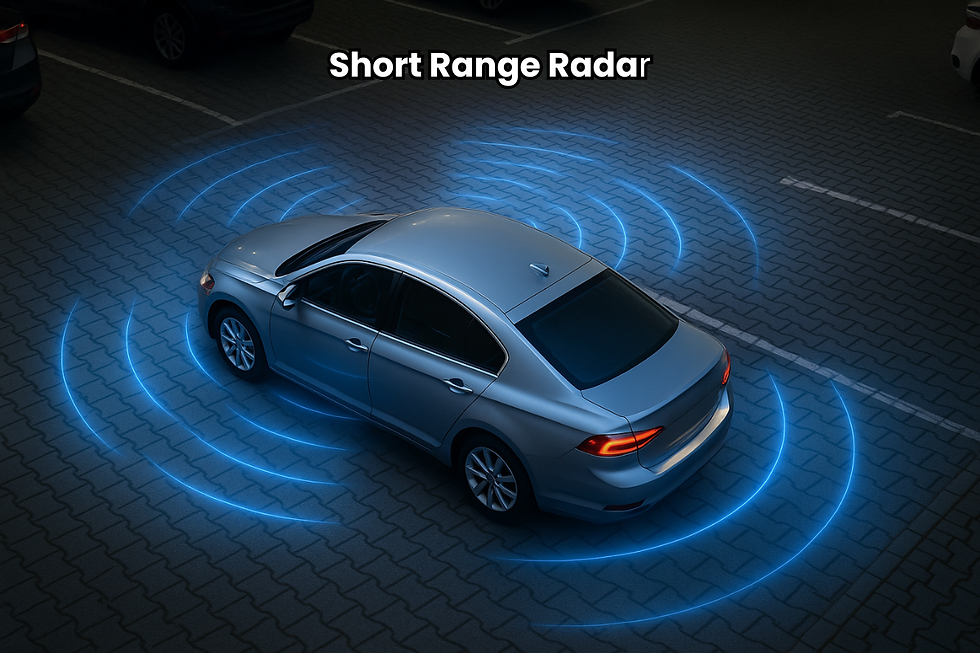
What Is Short-Range Radar (SRR)?
Short-range radar is designed to detect objects within 30–50 meters of the vehicle. It provides a wide field of view, making it ideal for sensing nearby obstacles, pedestrians, or vehicles.
Key Characteristics
Wide field of view (up to 150°)
High precision for close-range detection
Works well at low to medium speeds
Supports functions that depend on spatial awareness around the car
ADAS Features That Use Short-Range Radar
Blind Spot Detection (BSD)
Rear Cross-Traffic Alert (RCTA)
Parking Assist Systems
Lane Change Assist
Autonomous Emergency Braking (AEB – short-range scenarios)
Why SRR Works Best Here: These features need rapid, close-quarter detection, especially in urban driving or tight spaces.
What Is Long-Range Radar (LRR)?
Long-range radar can detect vehicles and objects up to 200–250 meters away. It offers a narrower field of view, which helps in tracking objects at high speed and long distances.
Key Characteristics
Narrow field of view (typically 10°–30°)
Excellent distance and speed measurement
Ideal for highway environments
Supports predictive and proactive safety functions
ADAS Features That Use Long-Range Radar
Adaptive Cruise Control (ACC)
Forward Collision Warning (FCW)
Autonomous Emergency Braking (AEB – high-speed scenarios)
Traffic Jam Assist (when combined with short-range radar)
Highway Pilot / Highway Assist Features
Why LRR Works Best Here: High-speed driving requires sensors that detect faraway objects and react early. LRR provides the stability and accuracy needed for smooth distance keeping and safety alerts.

Short-Range vs. Long-Range Radar: What’s the Difference?
Feature | Short-Range Radar (SRR) | Long-Range Radar (LRR) |
Distance | 0–50 meters | 50–250 meters |
Field of View | Wide | Narrow |
Speed Range | Low–medium speeds | Medium–high speeds |
Use Cases | Parking, blind spots, cross-traffic | Cruise control, collision warning |
Cost | Lower | Higher |

How Automakers Combine Both for Safer ADAS
Modern vehicles rarely rely on just one radar type. Instead, they use a radar fusion approach, pairing SRR and LRR with cameras, lidar, and ultrasonic sensors.
Benefits of Radar Fusion
More accurate environment perception
Better performance in poor weather (fog, rain, snow)
Smooth driving behavior at all speeds
Higher safety and reliability
ADAS Features Enabled by Radar Fusion
360° Perception Systems
Autonomous Parking
Hands-Free Highway Assist
Urban Autonomy Features

Adaptive Radar Range
Modern radar ADAS technology can automatically adjust its detection range based on speed, environment, and the ADAS feature in use. This makes radar more flexible, efficient, and reliable especially in India’s fast-changing road conditions.
How Adaptive Radar Range Works
Adaptive radar uses advanced signal processing to switch between short-range, medium-range, and long-range modes.
It widens the field of view to detect nearby obstacles.
It narrows the beam to track distant vehicles at high speed.
This allows one radar sensor to support multiple ADAS features without adding extra hardware.
Three Modes of Adaptive Radar
1. Short-Range Mode (0–30 meters)
Used when the vehicle needs wide-angle awareness. Ideal for:
Blind Spot Detection
Lane Change Assist
Cross-Traffic Alerts
Low-speed emergency braking
Short-range radar offers fast, precise detection in tight spaces and city driving.
2. Medium-Range Mode (up to ~100 meters)
Balances distance and field of view. Useful for:
Traffic Jam Assist
Urban driving
Smooth lane transitions
This mode helps vehicles understand both nearby and mid-distance movement.
3. Long-Range Mode (up to 200–250 meters)
Used at higher speeds where early detection matters. Supports:
Adaptive Cruise Control
Forward Collision Warning
High-speed Autonomous Emergency Braking
Highway Assist systems
Long-range radar gives the stability and accuracy needed for safer highway driving.
Which Radar System Is Better?
Choosing between short-range radar and long-range radar isn’t the goal each serves a different purpose in radar ADAS.
Short-range radar delivers precise, wide-angle awareness for close-range safety and maneuvering.
Long-range radar provides stable, far-distance tracking for high-speed driving and forward collision prevention.
With the rise of adaptive radar, modern vehicles no longer rely on a single fixed range. Instead, radar can shift between short, medium and long-range modes depending on the ADAS feature and driving environment. This flexibility creates a stronger, more intelligent safety system.
Final Thoughts
The future of vehicle safety isn’t about choosing SRR or LRR it’s about using both in harmony. When short-range radar, long-range radar, and adaptive radar work together often combined with cameras and other sensors they create a clearer, more reliable picture of the road.
This synergy powers today’s most advanced ADAS capabilities and will drive the next wave of radar-led innovation. As the demand for safer mobility grows, radar will continue to play a central role, helping vehicles navigate India’s diverse driving conditions with greater accuracy, consistency and confidence.


Comments