

Why 2026 Could Be the Year Radar-Based ADAS Goes Mainstream in India — Even for Budget Vehicles
- Marketing Starkenn
- 1 day ago
- 4 min read

Tables of contents
India is undergoing a pivotal transformation in road safety and vehicle technology. For years, Advanced Driver Assistance Systems (ADAS) were limited to premium segments. But the landscape is shifting rapidly, and 2026 is emerging as the breakthrough year when radar-based ADAS becomes common even in India’s budget vehicles.
With evolving regulations, greater OEM focus on safety, rapidly falling sensor costs, and India-specific driving needs, radar-powered ADAS is poised to become a mass-market technology.

1. India’s Road Safety Crisis Demands Reliable ADAS
India has:
One of the highest road accident rates in the world
Over 1.5 lakh fatalities annually
Extremely diverse road users; pedestrians, two-wheelers, animals, carts, autos
Challenging visibility conditions: fog, rain, dust, poorly lit roads
Camera-only ADAS struggles in many of these real-world situations.
Why radar matters for India
Radar performs consistently in:
Heavy rain
Dense fog
Glare and low light
Dusty or poorly marked roads
This reliability makes radar-based AEB, collision warning, and adaptive cruise control practically essential for Indian conditions.

2. Bharat NCAP Will Be a Key Catalyst for ADAS Adoption by 2026
The launch of Bharat NCAP has changed the automotive priorities in India.
From 2024 onward:
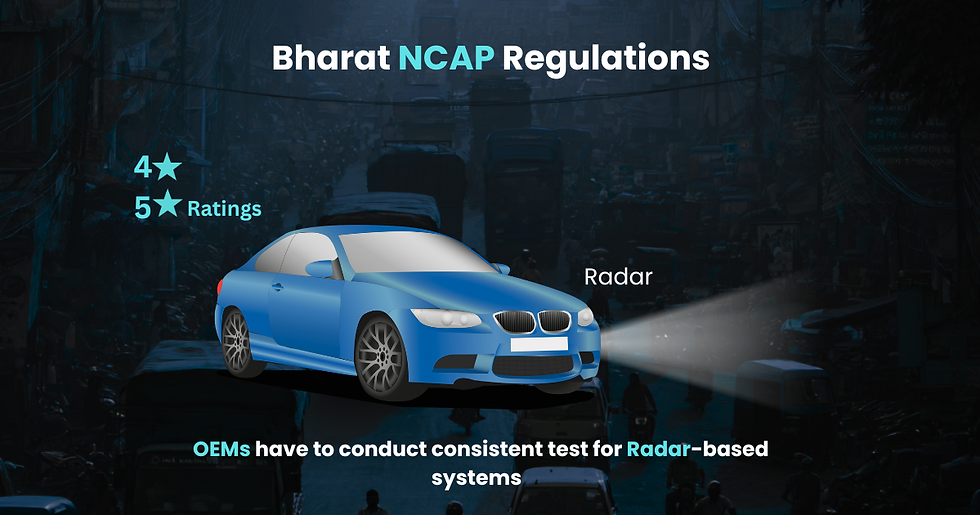
OEMs will compete aggressively for 4- and 5-star safety ratings
Higher ratings will influence consumer preference
ADAS (especially AEB and pedestrian detection) will increasingly become scoring criteria
Since radar significantly improves ADAS accuracy, especially in India’s unpredictable environments, OEMs will naturally gravitate toward radar-based systems to achieve consistent test results.
By 2026, analysts expect:
ADAS to become a differentiator in the mass market
Radar sensors to be included even in entry-level models
India-specific ADAS tuning to become standard
3. Radar Technology Is Becoming Affordable for Indian Mass-Market Cars
A major barrier to ADAS adoption in India has traditionally been cost sensitivity. But that’s changing.
By 2026, radar sensor prices are expected to drop sharply due to:
Local manufacturing & semiconductor incentives under Make in India
Wider adoption across global markets lowering per-unit costs
Integration of radar-on-chip (RoC) and antenna-on-package (AoP) technologies
Standardized platforms enabling OEMs to use the same radar hardware across multiple models
What once cost ₹20,000–₹40,000 per sensor could reduce to a fraction of that, enabling integration in vehicles priced between ₹5–10 lakh.
This cost democratization is a game changer.

4. Indian Road Conditions Require Radar + Camera, Not Camera Alone
India’s roads are vastly different from Western urban highways. Lane markings are often faded, unpredictable elements appear suddenly, and visibility can drop dramatically.
Here’s how radar helps where cameras fail:
Indian Challenge | Camera Performance | Radar Performance |
Heavy rain | Poor | Strong |
Fog (North India winters) | Very weak | Excellent |
Unlit rural roads | Limited | Strong |
Sudden pedestrian crossing | Inconsistent | Highly stable |
Dusty environments | Distorted | Unaffected |
This is why 2026 will see OEMs shifting to hybrid sensing (camera + radar) for reliable ADAS suited to Indian road realities.

5. 4D Imaging Radar & AI-Based Fusion Will Push ADAS into Budget Cars
India doesn’t just need ADAS, it needs India-optimized ADAS.
The emergence of low-cost 4D imaging radar and advanced perception algorithms (an area where Starkenn specializes) is enabling:
Precise object detection in dense traffic
Better classification of bikes, autos, pedestrians
Accurate distance and speed estimates in chaotic roads
Reduced false positives, making ADAS safer and more trusted
Why this matters for budget cars:
AI-driven radar fusion allows OEMs to deploy sophisticated ADAS features without expensive lidar or high-end compute.
This is exactly the kind of tech innovation that enables mass-market deployment.

6. India’s EV Boom Is Accelerating Radar Adoption
Electric vehicles; from Tata, Mahindra, MG, Hyundai to new-age OEMs, are aggressively adopting ADAS to differentiate.
By 2026:
Many EVs under ₹15 lakh will integrate radar-based ADAS as standard
Fleet EVs (ride-hailing, delivery) will demand robust safety systems
Government incentives will encourage safety feature adoption
This ecosystem shift helps radar scale faster and become cheaper for everyone, including petrol and diesel mass-market vehicles.
What This Means for the Indian Auto Industry
For OEMs
ADAS will become a competitive and regulatory necessity
Radar-based perception will be key to China-level cost competitiveness
India-focused ADAS tuning will be essential for customer trust
For Tier-1 Suppliers
Demand for compact, affordable, software-driven radar will surge
Ability to deliver India-optimized algorithms will define market leaders
For Technology Innovators Like Starkenn
Starkenn’s expertise in perception software, multi-sensor fusion, and AI-driven radar processing positions the company to lead the next safety revolution in Indian automotive technology.
For Indian Consumers
Safer cars won’t be a luxury. Even entry-level buyers will experience radar-backed safety features by 2026.
Conclusion: 2026 Is India’s Radar-ADAS Breakout Year
India’s unique road conditions, coupled with Bharat NCAP, falling radar costs, and strong consumer demand for safety, create the perfect environment for radar-based ADAS to go mainstream, not just in premium cars but across India’s most popular budget segments.
2026 is not just another milestone.


Comments